
Your Trusted Eyes on The Ground
Common Mistakes When Importing Furniture from Indonesia
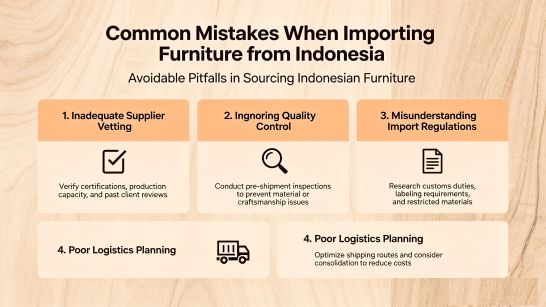
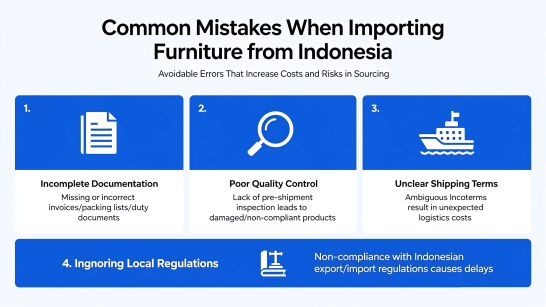
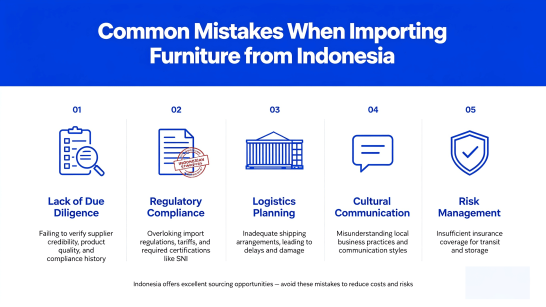
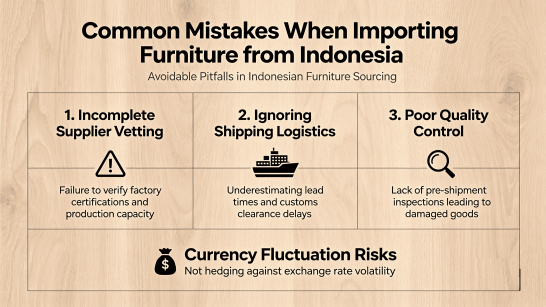
Indonesia offers excellent sourcing opportunities, but importers often make avoidable mistakes that increase costs and risks.
Why Indonesia Remains a Popular Furniture Sourcing Destination
Before discussing common mistakes, it is important to understand why Indonesia continues to attract global furniture buyers.
Indonesia offers:
- High-quality teak, mahogany, suar, and mindi wood
- Skilled woodworking craftsmanship
- Competitive labor costs
- Extensive export experience
- Strong custom furniture capabilities
- Large furniture manufacturing clusters
Major furniture production centers include:
- Jepara
- Semarang
- Solo
- Yogyakarta
- Cirebon
- Surabaya
Despite these advantages, buyers must implement proper sourcing procedures to achieve successful outcomes.
Mistake #1: Choosing Suppliers Based Solely on Price
One of the most common mistakes is selecting a supplier simply because they offer the lowest quotation.
While lower pricing may initially appear attractive, it often creates hidden risks.
Potential problems include:
- Lower-grade materials
- Inconsistent production quality
- Poor finishing standards
- Limited quality control systems
- Delayed deliveries
- Lack of export experience
Furniture is not a commodity product where price should be the only consideration.
A supplier offering a significantly lower price than competitors may be reducing costs through:
- Inferior raw materials
- Lower-quality hardware
- Reduced finishing processes
- Insufficient quality inspections
The cheapest supplier often becomes the most expensive supplier when defects, delays, and customer complaints occur.
Mistake #2: Failing to Verify Supplier Credentials
Many buyers rely solely on websites, brochures, or online communication without conducting proper supplier verification.
A professional-looking website does not necessarily indicate a capable manufacturer.
Buyers should verify:
- Company registration
- Factory ownership
- Export experience
- Production capacity
- Certifications
- Customer references
Before placing large orders, conducting a factory audit is highly recommended.
A factory assessment provides valuable insights into:
- Manufacturing capabilities
- Workforce skills
- Equipment condition
- Quality management systems
- Production planning
Mistake #3: Skipping Factory Audits
Some buyers assume factory audits are unnecessary, particularly when dealing with suppliers recommended by agents or online marketplaces.
This assumption can create significant risks.
A factory audit helps identify:
Production Capacity
Can the supplier realistically handle your order volume?
Quality Systems
Does the factory have documented inspection procedures?
Workforce Competency
Are workers properly trained?
Compliance Standards
Does the supplier comply with legal and customer requirements?
Factory audits provide critical information that cannot be obtained through email communication alone.
Mistake #4: Providing Incomplete Product Specifications
Many production issues occur because buyers fail to provide sufficiently detailed specifications.
Furniture manufacturing requires precise information.
Buyers should clearly define:
- Product dimensions
- Wood species
- Finishing requirements
- Hardware specifications
- Packaging requirements
- Labeling requirements
- Tolerance levels
Vague instructions frequently result in misunderstandings and costly rework.
For example, requesting a "natural teak finish" may be interpreted differently by different factories.
Providing reference photos, technical drawings, and approved samples helps eliminate ambiguity.
Mistake #5: Ignoring Material Verification
Raw materials significantly influence product quality and durability.
Some buyers focus heavily on finished product appearance while neglecting material verification.
Important material checks include:
Wood Species Verification
Ensure the supplier uses the agreed wood species.
Moisture Content Testing
Excess moisture can cause:
- Cracking
- Warping
- Joint separation
Material Grade Verification
Inspect for:
- Knots
- Splits
- Defects
- Insect damage
Proper material inspection should occur before production begins.
Mistake #6: Neglecting Quality Control During Production
A common misconception is that quality inspection should occur only before shipment.
Unfortunately, defects discovered at the final stage are often expensive and difficult to correct.
Professional buyers typically implement:
Pre-Production Inspection
Review materials and specifications before manufacturing begins.
During Production Inspection
Monitor production quality while manufacturing is ongoing.
Final Random Inspection
Verify completed products before shipment.
This multi-stage approach significantly reduces sourcing risks.
Mistake #7: Underestimating Lead Times
Many buyers assume production schedules will always proceed exactly as planned.
In reality, furniture manufacturing timelines can be affected by:
- Material shortages
- Peak production seasons
- Public holidays
- Weather conditions
- Shipping disruptions
Common production estimates:
Product Type Typical Lead Time Standard Furniture 30–45 Days Custom Furniture 45–90 Days Hospitality Projects 60–120 Days Buyers should always build contingency time into their schedules.
Mistake #8: Failing to Inspect Packaging
Even perfectly manufactured furniture can arrive damaged if packaging is inadequate.
Packaging inspections should verify:
- Carton strength
- Internal protection
- Foam placement
- Corner protection
- Product wrapping
- Shipping labels
International shipping exposes products to:
- Container movement
- Humidity
- Multiple handling points
- Long transit periods
Proper packaging reduces transportation-related damage.
Mistake #9: Overlooking Export Documentation
Furniture exports require accurate documentation.
Common export documents include:
- Commercial Invoice
- Packing List
- Bill of Lading
- Certificate of Origin
- Fumigation Certificate (when applicable)
- SVLK Documentation (for applicable products)
Documentation errors can result in:
- Customs delays
- Additional fees
- Shipment holds
- Import clearance problems
Buyers should verify documentation requirements before shipment.
Mistake #10: Not Understanding FSC and SVLK Requirements
Many international buyers fail to evaluate timber legality and sustainability requirements.
Depending on the destination market, buyers may need:
FSC Certification
Demonstrates responsible forest management and sustainable sourcing.
SVLK Certification
Verifies legal timber sourcing under Indonesian regulations.
Failure to verify these requirements can create compliance challenges and market access limitations.
Mistake #11: Poor Communication with Suppliers
Communication issues are among the leading causes of sourcing problems.
Common examples include:
- Unclear specifications
- Assumptions about requirements
- Delayed responses
- Language misunderstandings
Best practices include:
- Written confirmations
- Technical drawings
- Product samples
- Regular production updates
Clear communication reduces misunderstandings and improves production accuracy.
Mistake #12: Paying 100% Upfront
While deposits are standard practice, paying the full order value before production can increase financial risk.
Many buyers prefer structured payment terms such as:
- Deposit before production
- Balance after inspection
- Final payment before shipment
Payment structures should be agreed upon in writing before production begins.
Mistake #13: Not Having a Local Representative
Managing overseas suppliers remotely can be challenging.
Without local oversight, buyers may struggle to:
- Verify factory conditions
- Monitor production progress
- Conduct inspections
- Resolve issues quickly
A local sourcing partner can provide on-site support and improve communication between buyers and suppliers.
How INDOSE Helps Buyers Avoid These Mistakes
INDOSE supports international buyers throughout the sourcing process by providing:
Supplier Identification
Finding manufacturers that match product requirements.
Factory Audits
Assessing supplier capabilities before orders are placed.
Production Monitoring
Tracking progress and identifying issues early.
Quality Inspections
Verifying product quality before shipment.
Export Coordination
Ensuring documentation and shipping processes run smoothly.
Our goal is to help buyers reduce sourcing risks and build long-term relationships with reliable Indonesian manufacturers.
Conclusion
Indonesia offers outstanding opportunities for furniture sourcing, but successful importing requires careful planning and professional supplier management.
The most common mistakes include:
- Choosing suppliers based solely on price
- Skipping factory audits
- Neglecting quality control
- Providing incomplete specifications
- Ignoring packaging requirements
- Overlooking export documentation
- Poor communication with suppliers
By implementing proper sourcing, inspection, and supplier verification procedures, buyers can significantly reduce risks and enjoy the benefits of sourcing high-quality furniture from Indonesia.